Is pipa water safe in Cabo?
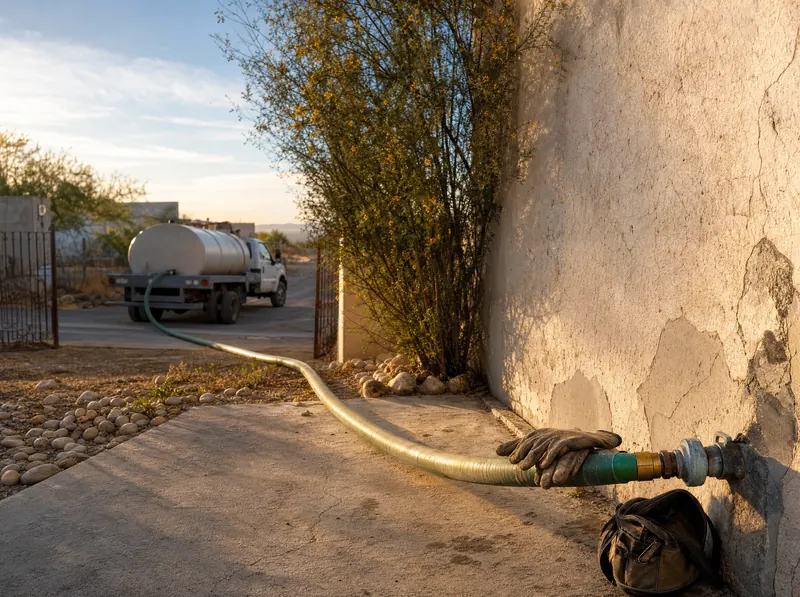
Pipa water is not one uniform water source. The quality of a delivered load can depend on where the truck filled, the condition of the delivery equipment, how the water is transferred and what happens after it enters your cistern or tinaco.
That means the most useful question is not “Are pipas safe?” It is:
What is the source of this delivery, what can we verify at delivery, and how is the property protecting and maintaining the water afterward?
For drinking and cooking, MirAqua recommends appropriately treated water unless testing demonstrates that the water at the point of use meets the applicable drinking-water requirements. For household uses, source transparency, sediment control, storage hygiene and appropriate testing are the practical priorities.
Why source transparency matters
A pipa is a transportation step, not a treatment technology.
The truck can carry water from different sources. The chemistry and microbiological condition of those sources can differ. Even official CONAGUA monitoring data show that groundwater chemistry in Los Cabos varies materially by site and over time.
So a pipa company should be able to answer a basic question:
¿De dónde viene el agua? — Where did this water come from?
Useful documentation can include a source receipt, fill record, dispatch record or other evidence that connects the delivery to the claimed source. The exact documentation available depends on the operator and source, but the principle is the same: source claims should be traceable where possible.
We avoid categorical statements that every pipa source is regulated, unregulated, chlorinated or untreated. Those claims require source-specific evidence.
The four control points in a pipa delivery
1. Source
Source determines the starting water chemistry and treatment history.
Municipal, groundwater and other permitted sources can have different mineral profiles and treatment conditions. A source that tested well last year also should not be treated as proof of every future delivery.
If source consistency matters to your property, record the provider and source with each delivery.
2. Truck and hose condition
Water can pick up particulate material or contamination during transport and transfer if equipment is poorly maintained. A clean-looking truck is reassuring, but visual inspection alone is not a water-quality test.
Professional operators should be able to explain their tank and hose maintenance practices. For higher-risk properties, those practices can become part of vendor qualification.
3. The fill point
The cistern inlet is one of the easiest places to prevent a recurring particulate problem.
A properly selected washable screen, sock, spin-down separator or cartridge stage can capture suspended material before it settles into storage. The correct device depends on fill rate, connection geometry, pressure and the type of material being captured.
Sediment filtration does not remove dissolved hardness and does not prove microbiological safety. Its job is simpler: keep suspended dirt out of the rest of the system.
See: Inlet Filtration for Cabo Cisterns.
4. Storage after delivery
The pipa leaves. The water remains.
Cistern condition, sediment, temperature, disinfectant residual, turnover and time can all affect stored-water quality. A delivery that starts with acceptable quality does not guarantee that the water will have the same condition after prolonged storage.
This is why we treat delivery and storage as one system rather than two unrelated services.
Read: Water Age in Cisterns.
What can you test when the pipa arrives?
Field measurements can answer useful questions quickly, but each measurement has limits.
Free chlorine: useful when you need to know whether a measurable disinfectant residual is present. The result should be interpreted in context; absence of residual is not, by itself, a complete microbiological test.
TDS / conductivity: useful for comparing mineralization and spotting a large change from previous deliveries. It does not identify the dissolved ions and does not establish microbial safety.
Hardness: measure this directly if scale and softener sizing matter. Do not infer hardness from TDS.
Turbidity / visual particulate: useful for identifying suspended material, especially when paired with inlet-filter inspection.
Microbiology: if the question is whether indicator bacteria are present, use an appropriate microbiological test or accredited laboratory method. A clear glass and a TDS pen cannot answer this question.
A strong sampling plan separates three locations when practical:
- At the hose / incoming delivery — evaluates the delivered water.
- In the cistern after mixing/storage — evaluates the storage system.
- At the drinking tap — evaluates what people actually consume after plumbing and treatment.
See Testing Your Water in Los Cabos.
What a dirty inlet filter actually proves
A visibly dirty inlet filter is useful evidence that the filter captured suspended material from one or more deliveries. It can support a particulate-control story.
It does not, by itself, prove that the water contained pathogens, heavy metals or unsafe dissolved contaminants.
This distinction is important for both technical accuracy and customer trust. We want to show real Cabo evidence — but describe exactly what that evidence demonstrates.
How to evaluate a pipa provider
A practical vendor check is straightforward:
Ask the source. A clear answer is better than a vague one.
Ask for documentation when available. Receipts or fill records make the source claim more credible.
Ask about tank and hose cleaning. You are evaluating operating discipline as much as the answer itself.
Record delivery volume and date. Consistent records help identify changes in consumption, pricing and source.
Measure when it matters. A few repeatable field measurements can reveal changes that memory will not.
For property managers, hotels and businesses, turn these into a written vendor standard rather than relying on whoever answers the phone fastest.
Is cheaper pipa water worse?
Not necessarily.
Price can vary because of delivery distance, load size, scheduling, source cost, route efficiency, season and market conditions. A low price is not proof of poor quality, and a high price is not proof of good quality.
Compare providers on price + source transparency + delivery reliability + documented volume + water-quality controls.
That is more useful than treating price as a quality test.
Can you drink pipa water directly?
We would not recommend drinking a delivered load directly based only on the fact that a provider describes it as potable. The final water at your tap has passed through delivery, storage and your property’s plumbing.
For drinking, use an appropriate point-of-use purification strategy or current testing that supports the intended use.
See: Is Cabo Water Safe to Drink?.
Does pipa water always contain chlorine?
No assumption should be made without measurement or source-specific documentation.
If maintaining a disinfectant residual is part of the property’s water-management plan, measure free chlorine at delivery and during storage. Chlorine demand and decay vary with the water and tank conditions, so we do not use a universal Cabo “days until zero” rule.
Does an inlet filter make pipa water potable?
No.
An inlet sediment filter can remove suspended material according to its rating and system design. It does not remove dissolved hardness and does not, by itself, provide comprehensive microbial or chemical treatment.
Think of it as Layer 1: keep dirt out, not as the entire water-safety system.
A better Cabo pipa standard
For a property that depends on delivered water, we recommend building a repeatable record around every delivery:
| Record | Why it matters |
|---|---|
| Provider | Tracks consistency and performance |
| Claimed source | Establishes the starting point for verification |
| Date/time | Links the delivery to tank level and water age |
| Volume | Helps verify consumption and delivery accuracy |
| TDS/conductivity | Screens for major mineralization changes |
| Hardness when relevant | Supports scale treatment and softener sizing |
| Free chlorine when relevant | Tracks disinfectant residual |
| Inlet-filter condition | Documents particulate loading |
| Notes/photos | Creates field evidence over time |
One measurement is a snapshot. A repeated dataset becomes local intelligence.
That is where MirAqua can become genuinely useful as a Cabo water authority: not by claiming every truck is good or bad, but by documenting what actually arrives at properties and showing the patterns over time.
Frequently asked questions
Is pipa water safe for showering and laundry?
That depends on the specific water and property, but hard water or visible scale alone does not mean water is unsafe for normal household contact. If there is a known contamination event or health advisory, follow the applicable guidance.
Can a TDS meter tell whether my pipa water is safe?
No. It measures electrical conductivity and estimates total dissolved solids. It is useful for comparing mineralization, not for detecting bacteria or identifying individual contaminants.
Should I test every pipa load?
Not every property needs laboratory testing on every delivery. A risk-based plan can combine source records, repeatable field measurements and periodic laboratory testing. Higher-risk commercial properties may justify a more formal program.
How can I reduce sediment from pipa deliveries?
Evaluate the inlet geometry and install a sediment-control stage that can handle the actual fill rate without causing overflow or excessive restriction. Inspect what it captures and use that evidence to adjust filtration or provider selection.
What should I do if a delivery suddenly looks or smells different?
Document the provider, time and source claim; stop using the water for ingestion until you understand the change; compare field measurements with prior deliveries; and test the relevant parameters if the cause is unclear.
The MirAqua approach
We treat pipa delivery as the first link in a property water chain:
Source → delivery → storage → measurement → treatment → monitoring.
If you only manage the truck, you miss what happens in the cistern. If you only install a filter, you miss the source. If you only test once, you miss variability.
The goal is not to make Cabo water sound scary. The goal is to make it observable, documented and manageable.
Next: Test your water · Protect the cistern inlet · Understand Cabo water safety · Get My Water Plan